‘All The Beauty And The Bloodshed’ At Mockingbird Cinema From 27/01/23

Writer Jimmy Dougan / Images from Nan Goldin and P.A.I.N


Acclaimed photographer Nan Goldin thrives in the edges. Her world is dimly lit, glanced fleetingly in a bathroom mirror or through the cigarette haze of a back-alley dive.

Her work, capturing 70s New York and beyond, is comforting and intimate yet violent and bleak. In one of the hundreds of images compromising her iconic The Ballad of Sexual Dependency, she stares back at us: her autumnal frizz frames a pale face defined by two purple welts around her eyes, inflicted by a boyfriend.

In another, an emaciated man lies dying from AIDS-related causes in a hospital bed as his partner tenderly kisses his forehead. Scrawny drag queens apply makeup in the back of a cab, nude lovers reach for each other in filthy bedrooms.


The intimacy of Goldin’s photography is the perfect subject for documentarian Laura Poitras’ searing new film, All the Beauty and the Bloodshed, which releases in UK cinemas from 27 January.

“I survived the opioid crisis. I narrowly escaped,” Goldin narrates. She was hooked on OxyContin, a highly addictive prescription drug manufactured by Purdue Pharma, a company owned by the Sackler family. Known for their artistic philanthropy, the Sackler name tarnishes the walls of galleries on a global scale, from the Guggenheim to the Tate to the Louvre.

Goldin’s fury is palpable. The opioid epidemic is a manufactured crisis, and she holds the Sackler family responsible for the fatal overdoses of over 500,000 Americans. To highlight this, she formed the protest group Prescription Addiction Intervention Now or (P.A.I.N.), composed mainly of recovering addicts and the loved ones of the dead.


All the Beauty and the Bloodshed is almost two films in one. Like Goldin’s photography it resists easy categorisation, deftly skipping across the years to give us both an evocative portrait of a singular artist, and a taut documentary about unchecked capitalism and a fringe-group committed to fighting it.

I am struck by the way Poitras’ posits Goldin’s drive for justice as resulting not only from her experiences with OxyContin, but from a miserable childhood in a repressed suburban home.

When Goldin was 11, her sister Barbara ended her own life at the age of 18. Goldin speculates, gently, that perhaps her sister couldn’t confront her own burgeoning homosexuality. The death was swept under the rug and Goldin – who recounts overhearing her parents decide to tell the family it was accidental – was sent to a foster family, just like her sister had been.


The spectre of Barbara haunts the film, even down to the title. This is, in a way, a reckoning. But I also get the impression that Goldin is calling out to Barbara across the ether for forgiveness. Goldin has seen what shame and repression can do, and she won’t let it happen again. Goldin isn’t protesting. She is crusading.

A chronic smoker, Goldin’s narration is gravel-rough. While some of her observations about her life in 70s New York can border on cliché (her first roommates were “running away from America”, apparently), there is a heightened poeticism to her words which brilliantly evokes a very particular time and place in American history.

Titans of art pass through the frame like displaced travellers, and I wonder if Goldin isn’t evoking so much as resurrecting: Cookie Mueller, David Wojnarowicz, Maggie Smith’s Tin Pan Alley. All are remembered, then delicately – gloriously – fall back into the cosmos.


Poitras lets the material breathe: swathes of the film simply set Goldin’s grainy videography to the music of the era. Her directorial flourishes are minimal yet impactful, such as dividing the film into seven titled chapters. Each begins with a sequence of photographs or filmed footage from Goldin’s life accompanied by her commentary, before sharply switching to the present day to follow P.A.I.N.

These latter sequences grip like a thriller, a feeling heightened by Poitras’ handheld camerawork and narrated testimony from The New Yorker journalist Patrick Radden Keefe.

Goldin’s protests have the touch of an artist: a fountain in the Met’s Sackler Wing is filled with empty pill bottles. Prescriptions rain down from the Guggenheim’s atrium, a child plays amongst corpses outside the V&A.

It is strange and beautiful.


All the Beauty and the Bloodshed is a singular work, representing the perfect marrying of two artists. It demonstrates a kind of synthesis between form and content, Poitras’ rare willingness to expose the corrupt and powerful collides with Goldin’s own experiences with grief and addiction.

Not since 2012’s The Act of Killing has ‘the documentary’ felt so exciting and raw, a medium of genuine political potential which seeks to radically undermine, and subsequently transform the ways in which we experience the world.

To the extent we can confidently discuss the future of any medium in the present moment, I feel like the future of the documentary is here.

All the Beauty and the Bloodshed – official trailer

All the Beauty and the Bloodshed will be screened at Mockingbird Cinema, at The Custard Factory, from 27 January to 2 February.

For full listings and links to online ticket sales visit: www.mockingbirdcinema.com/production/all-the-beauty-and-the-bloodshed

To read more about Nan Goldin and P.A.I.N. go to: www.sacklerpain.org

For more on Mockingbird Cinema visit: www.mockingbirdcinema.com

‘The Most Enthusiastic Crowd We’ve Ever Had’: Big Joanie With Support From GHUM At Hare & Hounds 12/01/23

Writer Sadie Barnett / Photographer Sam Aves


As I enter Venue One at Hare and Hounds, the crowd is full of anticipation. This gem of a venue in Kings Heath is known for its eclectic sounds, and Big Joanie’s support from GHUM is no exception.

London based post punk band GHUM take to the stage with an almost intimidating display of suspense as they begin to play ‘Rivers’, the closing song from their 2022 album Bitter. As guitarist Jojo Khor and bassist Marina MJ slowly start up behind her, lead singer Laura Guerrero Lora steps up to the mic. Clad in a black leather trench jacket, she looks every part the rockstar. I hear someone behind me exclaim that she “looks like Stevie Nicks!”


For a brief moment, Lora stares defiantly into the crowd. Then, drummer Vicki Ann begins to play and the entire band is transformed. As she sings, Lora dances to the drum beat with a captivating abandon, drawing the audience in with an energy that doesn’t fade throughout the set.

The drums, already a pounding presence, only become louder as the band speak directly to the engineers, asking for more sound. “Yeah more for me please, thanks,” asks Ann politely, before proceeding to shake the very foundations of the room.


GHUM’s sound is an exciting one, ranging from grunge, with songs such like ‘Shallow’ which show off Lora’s vocal range with dragged-out shouts of “you don’t know me”, to punkier songs like ‘Perro’. ‘Perro’ is my favourite of their set, sung entirely in Spanish as a homage to the Spanish and Brazilian heritage of the group.

The song tells a story of animalistic rage, a message that – despite the majority of the audience not speaking the language – is clearly translated, proven by the crowd who are headbanging enthusiastically. Towards the end of their set, GHUM pay tribute to the main act, telling us that it is “an honour to be on tour with such amazing women”, and dedicate their next song ‘1000 men’ to Big Joanie.


By the end of the track, the crowd are chanting along to the lyrics: “a thousand men can’t keep me safe!” It is a fierce reminder of the message of feminism at the heart of this tour, and a heartwarming moment given all of the work Big Joanie has done to make space for minorities in the punk and DIY scene.

This space is one that is clearly appreciated, not only by the band, but also by the audience – which is conspicuously lacking men.

The crowd cheers raucously as GHUM leaves the stage and the room proceeds to get even more tightly packed as we wait for Big Joanie. With all eyes ahead, it’s a bit of a surprise when they casually make their way through the audience and onto the stage.


I am left slightly bewildered as I shuffle out of the band’s path, however this surprise doesn’t last for long as the crowd begins to cheer wildly.

“It’s nice to be in Birmingham!” shouts drummer Chardine Taylor-Stone, to answering shouts of “0121!”

“This is actually Steph’s hometown gig,” she tells us, gesturing to singer and guitarist Stephanie Phillips and prompting another round of cheering. There’s nothing a Brummie crowd loves more than a Birmingham artist.

Big Joanie open with ‘Cactus Tree’, a standout single from Back Home (2022), the album that they are touring. This song combines a mesmerising blend of rock and folk with airy vocals and heavily distorted guitar over a strong drum beat. It is a striking opening.


Taylor-Stone in particular stands out here. In a rarely-seen example of a drummer taking centre stage, she plays standing up at the front, wearing a floral dress that matches the flowers draped across her instrument. It’s a thoughtful addition to their unique staging, with Phillips, Taylor-Stone, and bassist Estella Adeyeri standing in a straight line facing the crowd, joined at the back by Vanessa Govinden, bassist from Whitelands.

The crowd is joyful as the band plays through Back Home, bopping about the stage, smiling at audience members flinging their limbs at the front. To the crowd’s absolute delight, Taylor-Stone tells us these Brummies might be the “most enthusiastic crowd we’ve ever had, even with our big show in London!”

This, of course, cues more dancing, a celebration reinforced by their next song, ‘Confident Man’.

Again, the strong feminist politics of Big Joanie’s music rings through. Phillips tells us: “we shouldn’t admire those straight, white, greedy men”, who’s “morals aren’t really up to scratch”.


I nod fervently, hoping that the men stood in front of me obscuring mine and my friends’ view internalise this message. Although the topic is anger-inducing, the song’s bouncy synth line keeps us upbeat throughout.

We get a few throwbacks from the band’s 2018 album Sistahs, and are informed the women who appear on the album’s cover are in the audience tonight. The whole crowd giggles and cheers as the pair wave excitedly.

Through regular interludes, Big Joanie encourage moments of solidarity, with women, with gender minorities, with black and other POC communities, with workers and strikers. The crowd listens, rapt. I am sure I am not alone in thinking this kind of solidarity has been noticeably absent from so many punk shows recently, another reminder of why Big Joanie remain such a refreshing change for many of us.


We cheer in agreement as Big Joanie remind us: “even in our protest movements, there’s still issues we need to iron out.” The tightly packed audience moves even closer together, inspired. I see arms around shoulders and friends hugging, the crowd embracing in solidarity.

Big Joanie finish on their 2020 cover of Solange’s ‘Cranes in the Sky’.

As with many fans, this cover was my entry point into the band. We wait in quiet anticipation as Taylor-Stone begins the slow drum beat with a shaker in one hand, Phillips picks up a tambourine to accompany her vocals, and Adeyeri’s blissful harmonies elevate the main body of the sound.

“You’re all dancey,” notes Taylor-Stone. That we are.


For more from GHUM go to: www.ghum.bandcamp.com/music
For more from Big Joanie go to: www.bigjoanie.com

For more from Hare and Hounds go to: www.hareandhoundskingsheath.co.uk
For more from Decolonise Fest go to: www.decolonisefest.co.uk

Passing Fancies Is No Passing Fancy: A Cutting-Edge Bar Built On Community Values

Writer Mark Roberts / Photographer Connor Pope


Passing Fancies, open Wednesday through Sunday, is an unassuming glass fronted bar opposite the large ‘Foliage Man’ (I’ve trademarked the name, before you ask) in the Custard Factory. It’s fancy without ‘classy’ expectations, specialising in reasonably priced, curated boutique cocktails and small plates.

When you meet Thomas Matthews you see why Passing Fancies is swiftly becoming the go to place for cocktails in Digbeth, the passion and personality for excellent, affordable, beverages starts at the top and flows generously all the way down to the bartenders.

Tommy is one of three owners of Passing Fancies along with Eve Green from Grain & Glass, and Matt Arnold of The Edgbaston Boutique Hotel. He greets me warmly at the door and offers me an unfiltered Stella Artois, which as someone who doesn’t like lager, banged.


We sit down at the bar and I ask Tommy what spurred the idea of Passing Fancies.

“I started competing at a national level in 2016, and it was always this ongoing joke that wherever the finals were being held, we [Birmingham] were the butt of the joke.”

“I took that really personally”, Tommy continues. “We don’t have the densest population of great bars like London does, but we still have quality. We still have smart, driven and creative people.”

Community is something Tommy is eager to talk about, something that clearly drives him, and this passion is focused on Birmingham and its developing bar scene.

“I look at the industry as being one community. No matter what bar you work in,” Tommy explains with a laidback but palpable enthusiasm. “We’re all still in hospitality, we’re all doing the same thing. We just do it to different levels.”


And “different levels” is Tommy being modest. Tommy is an award-winning bartender, and was bar manager of Couch in Stirchley which ranked No 37 in Top 50 Cocktail Bars 2022, and The Edgbaston Boutique Hotel ranking No 24 and 25 in 2018 and 2019 respectively.

On top of Tommy’s credentials, Passing Fancies has just received a 9/10 in Class Bar Magazine, probably the industry’s biggest bar publication.

“We got lucky”, explains Tommy when the recent accolade is brought up. “I used to work at The Edgbaston Boutique Hotel and I heard that unfortunately they were closing, so I hit them up.

“We got £20-24K’s worth of kit for peanuts”, says Tommy, pointing to a centrifuge in one corner and a rotary evaporator in the other.

The conversation develops as we talk about the kit he’s using.


“It was a building site in here, and we had the bartenders from Couch learning how to use the centrifuge,” Tommy laughs.

“I don’t like people that hoard information. I’ve never understood the secret recipe side of things. If everyone knows all the secret recipes, is everyone not just better as a whole?

“There’s this beautiful line between plagiarism and inspiration and I think when you believe people will be inspired by your techniques, they’ll have their own version with their creativity.”

Maybe everything is a remix after all?

“The scene is just blossoming the more people talk to each other”, Tommy gleams.

Passing Fancies is also built upon the idea of community, from the inside. Tommy remembers his bartending past and explores his business model with me.

“So I sat down with Matt and Eve, and we chatted about our combined two decades of experience in hospitality. We’d been through the not so nice employers and the 90 hour weeks,” Tommy laments.

“We just looked at it and went ‘what didn’t we like when we were in the trenches?’”


Tommy goes on to describe an all too familiar story in the industry. “The lack of respect, this assumption that you’d come in on your day off to do stuff, zero hours contracts, your head on the chopping block to go home but you’ve still got bills to pay.”

Because of this, Passing Fancies decided to incorporate a fixed salary, fixed hours, and a 5% service charge equally split between all bartenders.

Tommy clearly understands the logistical issues with zero hours contracts: “You’ve got this crazy up and down weekly pay that you have to try to explain to the banks if you want a mortgage.

“Even if you work in hospitality, you should be entitled to the ease of getting the things you want in life.”

It’s important to note that Tommy, Matt, and Eve are all, fundamentally, bartenders in the eyes of the bar. “Now obviously there are perks for Eve, Matt, and I being business owners – but the directors are bartenders in the eyes of the bar. It’s super transparent.”

Tommy comes to an epiphany. “Now I say it aloud, it sounds very socialist and I mean I’m not into politics at all.”

I nod in Marxist approval.


“Sometimes when you have a bar manager who is this super, crazy, skilled person, sometimes that intimidation gets in the way.” Tommy goes on, explaining another aspect of his, Matt, and Eve’s business decisions.

“They (workers) don’t want to come across as stupid, or get laughed at or whatever. We’ve created this even playing field so everything is just a flavour lead conversation on what is delicious.”

For Tommy at least, this is the foundational idea behind Passing Fancies.

“The one thing all of the team ask before anything goes on the menu is, is it delicious?”

And I can vouch for them. The cocktails, the beer, the whiskey Tommy gave me after the interview – both of them – are outstanding.

If you’re in the Custard Factory and you’re passing, you should fancy a pass into Passing Fancies. Okay I’m bad at endings. Can you blame me? They plied me with booze.


To book a table at Passing Fancies go to: www.passingfanciesbar.co.uk

Tom Ford’s Insights On Music, McDonald’s And Home-Cooked Meals

Writer Jasmine Khan / Photographer Connor Pope


Heading to The Spotted Dog before hours risks bumping into their seemingly strict landlady, but jazz guitarist and growing local legend Tom Ford says the pub feels most like home in Brum, so we’re risking it. Welcomed in from the rain by the landlady, she’s much less stern when you’re not pushing your luck after last orders, and she lights a cosy fire to dry us off.

‘The Dog’ is a notorious Birmingham pub with its original woodwork, quirky decor and plentiful candlesticks in Jameson’s bottles. Tom and I soon find ourselves seated in front of the smouldering fireplace. Fair warning, I know this chat might get a tad deep.

We both agreed too many interviews centre around emphasising an artist’s social media persona, rather than exploring what they really think. Ahead of our interview, Tom said: “Music can either be McDonalds, or a home-cooked meal”, and that stuck with me.

“Everything with this stuff is super subjective”, says Tom when I remind him of his previous statement which summarised a larger discussion around entertainment and authenticity. Delving back into it, Tom explains there’s nothing wrong with McDonald’s music, it can be great to play and you can play entertaining music authentically.

But home-cooked meal music hits differently.


“Last year I listened to an Australian band called Amyl and The Sniffers, they’re a punk band”, muses Tom. “It’s not that they’re breaking ground with new sounds you haven’t heard before, but the authenticity of what they’re doing is so strong.

“Their ‘originalness’ breaks through the constructs of the genre they’re playing.”

To Tom at least, authenticity isn’t about what you’re playing, or how, or maybe even why you’re playing a certain song. It’s about an immersive and intuitive energy a musician must bring to feel genuine, one which relays the meaning behind the music they’re playing without performatively forcing it down the audience’s throat.

Getting closer to home Tom smiles and says, “One of my favourite musicians is… I’m going to say Liam’s last name wrong now”, referring to well-known local psych musician Liam McKeown.

“Liam’s in so many different projects and I feel like if he’s involved in a project, he adds so much weight to stuff. Even when he’s playing a more subdued background role.

“He’s one of the most natural musician’s I’ve heard; it doesn’t matter what setting he’s in, he’s him.”


We conclude that music which intends to entertain can be just as authentic as music which intends to bare the artist’s soul. But the issue arises when everyone’s expected to make music and market music at the rate of a fast food franchise, if they want to be successful that is.

“There’s this ongoing debate about the pros and cons of modern technology, connectivity”, tells Tom. “It’s difficult for young musicians because there’s an expectation to fit a certain template and also have a skill that wasn’t needed before.

“There’s this stress for musicians, any kind of creative person who has to survive, there’s more of an importance placed on content creation.

“It’s something a multimedia specialist would’ve done 10 years ago, but now it’s something that everyone’s got to master, and still have time to write music and perform.”

Tom continues: “From an authenticity point of view, the problem is people follow set permitters that other people have been successful with. You get that in music, that happens in a creative way, it can lead to great stuff.

“But, in a social sense, you see people pressured into joining in with the same thing as everyone else, and I think if anything it’s going to stop people from having the confidence to find themselves and be authentic.”


We agree, if an artist is naturally passionate about content creation then it’s a win-win. But if not, social media marketing expectations can drain creative energy like nobody’s business.

So Tom, you’ve got a good social media following but you’re clearly not that into social media, how do you manage it?

Tom replies, “It’s important to engage on some level, but I feel confident in the idea that if you’re struggling to find your place in it, wait until something feels natural and in the meantime use it for your local network.

“People will hear about you. If you have 1000 followers but they’re people that you actually want to have direct contact with that’s great, that’s what it should be used for.

“In terms of the stress of thinking you need to go viral. Well, that’s no different than thinking I’ve got to win the lottery or I need to have a hit single – there’s no sure fire way to do it.

“Even if you do a gig at The Sunflower Lounge to 10 people, and eight of the 10 people have never heard of you. But four of those people want to go to your next gig…

“The Australian band are a perfect example, their Spotify streams are not bad but not that good. That being said I know people with more [stream] that can’t sell rooms out like Amyl and The Sniffers.

“Online doesn’t always translate to real life.”

Tom Ford’s upcoming track titled ‘1998’ will be released on 8 January, and he’ll be live and in conversation at Hockley Social Club on Thursday 16 March following his latest EP dropping on March 10.


For more from Tom Ford go to: www.thetennischampion.bandcamp.com

For more from The Spotted Dog: https://www.facebook.com/profile.php

Dimes Have The Home-Field Advantage At The Dark Horse 22/12/22

Writer Jimmy Dougan / Photographer Maddie Cottam-Allan

The Dark Horse chills contentedly in the centre of Moseley Village, the black and gold frontage giving way to the kind of bar that could easily be slipped into a verse of ‘Fairytale of New York’ without anyone noticing. Tonight it’s bustling, lit by an infinitesimal number of candles and fairy lights.

In the pink-lit upstairs venue, there’s something in the air – the anticipatory, hopeful spark that something very special might be about to happen. Two notes for the unaware.

Firstly, Dimes were formed in mid-2021.

This quartet describes their sound as being no frills, no gimmicks rock ‘n roll. When I first saw Dimes live back in May, I was struck by the startling vein of anger coursing under everything they do, the damning indictment of our cruel and vacuous neoliberal culture in their snappy lyrics.

They ask, time and time again, how did we end up here? What went wrong? Could we not be doing things differently? They demand an answer.

Secondly, Dimes’ drummer, Simon Dunn, works at The Dark Horse.

The home-field advantage is strong, and the crowds come through. Within ten minutes of doors opening the venue is packed, and cries of “up the Dimes!” ring through it.

Two support acts kick us off: first up are Exotic Pets, proving appearances can absolutely be deceiving. Their warm, affable presence quickly gives way to a distinctly low-fi garage punk. One song sees them repeatedly, “I want to drink your blood”.

It’s initially quite funny, then oddly romantic.

Up next it’s Otherless, formerly known as EXHALER. My ears prick up towards the end of their set, which contains their strongest work: guitars become warped and elastic, drums slide towards staccato, words giving way to sounds. It’s challenging, provocative stuff. I’m reminded of Godspeed You! Black Emperor, or maybe even Angelo Badalamenti’s work on Twin Peaks: The Return.

As the tension in the room reaches fever pitch, Dimes finally appear. They’re unpretentious and direct, purposeful and clear. Tom Carwardine on vocals takes a minute. Do the lights catch a glimmer of pride in his eyes, or a smile curling at the corner of his mouth? Perhaps. He’s an excitingly enigmatic presence.

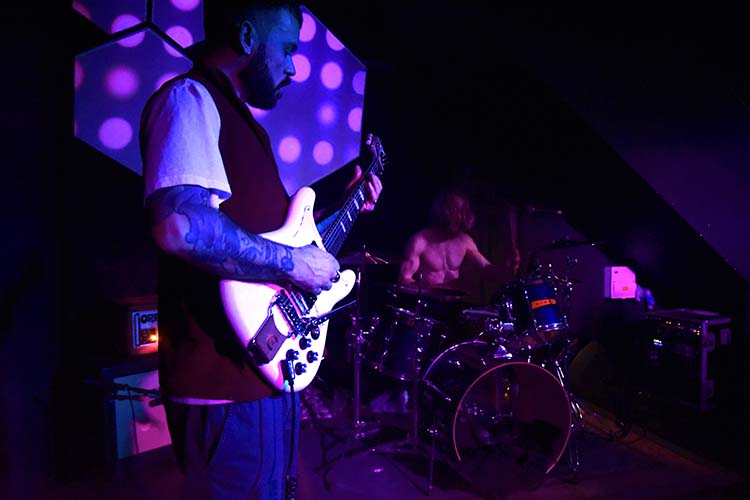
The crowd are losing it – a few of the staff have snuck off the bar too, and gladly add their howls to the chorus – but the band aren’t fazed. As we start off with the now iconic ‘State Run Press’, James paces and gesticulates: Dimes have a point to make, and they’re pissed. You quickly come to realise that Tom isn’t pacing, he’s prowling. He beats his chest, his brow furrows.

As we move into ‘Violent Undertones’ the moshing begins. When I last saw Dimes back in May, I was impressed. Tonight is next level. There’s a polish to this performance that you can’t help but get swept along by, a watertight dramaturgical logic expertly calibrated to get the crowd going. Nothing is superfluous.

The sound is incredible and hits us like a brick wall, props to the venue. Midway through their set when Tom casually thanks us all for coming, our reply is so loud I worry my eardrums might pop.

Watching Dimes is a communal experience – they’ve quickly carved out a real niche in the Birmingham music scene, and their reward has manifested itself as a loyal following which earnestly engages with the politics of the lyrics.

In an age revealing itself to be defined by shallow commercialism and ideological cowardice, it’s thoroughly refreshing to see a band grapple with such unashamedly political themes. Dimes are at their most thrilling when they lean into their sludge metal influences as they do on ‘Crony Capital’ and ‘Coming Down’.

The abrasive harshness of the lyrics melts into the political and aligns itself perfectly with relentlessly heavy drumming and roaring strings. The bass feels like being dragged across concrete.

It’s clear that Dimes aren’t out to seduce the unconverted but are here to galvanise the angry, huddled masses. The image they paint of modern Britain is a grim one, a decaying nation ruled by crony capitalists and scumbag charlatans being dismantled and sold into oblivion. Scrap the railways, let the nurses burn.

Dimes don’t claim to have any solutions, but watching them perform live the possibility of a wholly different society emerges; I am filled, not infrequently, with hope. I genuinely cannot wait to see what’s next for this electric and viscerally engaging quartet.

Up the Dimes indeed.

For more from Dimes go to: www.dimesbhx.com

For more from Otherless go to: www.otherless.bandcamp.com
For more from Exotic Pets go to: www.linktr.ee/exoticpets

For more from The Dark Horse go to: www.darkhorsemoseley.co.uk